

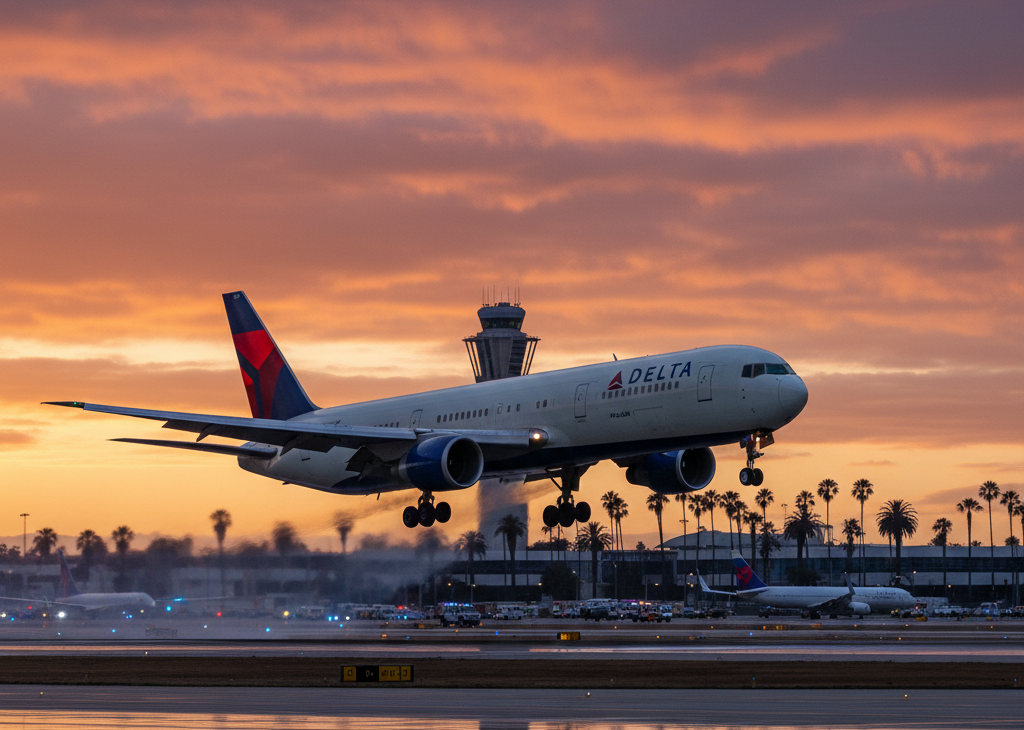
Air travel is the wonder of the modern day engineering, whereby continents and cultures can be interlocked within a few hours. There are millions of flights that occur and land safely every year. However, sometimes the unforeseen occurs. A normal trip is distorted, and passengers are plunging to an airport that they did not want to go to.
This disruption has recently been felt by the travelers on a given Delta connection. News of the Delta Flight DL275 Diverted LAX created some questions in the minds of people about what transpired behind the scenes. Getting some insight into flight diversions, such as why they occur, management, and how passengers perceive them, can turn a stress case into a manageable inconvenience.
This paper discusses the experience of the Delta Flight DL275 and deconstructs the history of the incident that caused the plane to land in Los Angeles unscheduled. We will look into the procedures that ensure the safety of the travelers in the event of a change of plans during flight, starting with the decision of the cockpit to the experience of the passengers on the ground.
History of Delta Flight DL275.
We must first consider the routine in order to appreciate the disruption. Delta air Flight DL275 is an average long route flight. This flight number can be frequently connected to transpacific or transcontinental flights, normally using wide-body aircraft that is capable of covering long distances.
Origin and Destination
Typically, this is an intermediate flight between the key hubs, e.g. Detroit (DTW) to Tokyo-Haneda (HND) or other international airlines. They are long-haul routes that are important not only to business travelers but also to recreational travelers as well, to travel long distances.
Aircraft Type
In the case of a route of this scale Delta normally uses a flagship aircraft, like Airbus A350 or A330. These jets have state of the art avionics, a huge fuel capacity as well as passenger comforts that accommodate 10-14 hour flights. They are constructed to suit various weather conditions and other operational difficulties.
Typical Flight Path
The typical route of the flight of DL275 is a Great Circle route, flying the plane north over Canada and Alaska and down the Russian coast or across the Pacific Ocean, depending on the jet streams and geopolitical restrictions of the airspace. It is the road which is traversed very closely by air traffic controllers in various countries.
The Diversion Event
The normalcy of the flight was interrupted as the decision to change the route was made. The time Delta Flight DL275 Diverted LAX, a complicated sequence of operational changes started.
Date, Time, and Location
Although particular diversion dates may also be different according to the individual cases, the divergence on this route is usually made after a few hours into the flight. Should the airplane continue to fly over North America or the early Pacific, Los Angeles International Airport (LAX) is one of the major diversion hubs because it has the capacity to take huge infrastructure and maintenance.
Initial Announcement
The initial indicator of trouble to the passengers is normally a cockpit chime. The professional voice of the captain is calm and informs the cabin that the flight plan has changed. In the example of DL275, the message probably said that because of operational issues, the plane would be flying south towards California instead of flying across the ocean.
Reasons for Diversion
So how come I am flying to Tokyo but end up in Los Angeles? Diversions are always expensive to airlines in terms of fuel, man hours and compensation of passengers. The four key categories of decisions leading to the decision to divert are usually motivated by decision.
Medical Emergency
A medical emergency is one of the most frequent causes of a mid-flight diversion. In case of a seriously ill passenger or crew member, the pilots should land in the nearest appropriate airport that has proper medical facilities. LAX, with its closeness to large hospitals, tends to become the destination of flight Pacific-bound flights with the need to turn back.
Weather Conditions
Although the modern jets are able to withstand harsh weather, intense turbulence, volcanic ash or typhoons at the destination may compel a change of plans. Nonetheless, a re-direction of a route to LAX to the north would be an indication that all was not well with the aircraft or one of the passengers and not the weather at the destination.
Mechanical Issues
The aircrafts in the modern world possess redundancy in their systems and functionality, meaning that the failure of a system is compensated by another. Nonetheless, there are some mechanical signs, which require a safety first policy, e.g. a sensor alert, a hydraulic problem, or an engine malfunction. In case a non-critical yet worrying mechanical problem is encountered before the flight has taken off to the open ocean (where there are no diversion airports), the captain will divert back to a major hub such as LAX to have it repaired.
Security Concerns and Other Factors.
Security breaches or rowdy passengers can be a cause of a landing though it is not common. Also the operational restrictions such as crew duty time restrictions (in case the flight was delayed during take-off) may also sometimes compel a stop to replace crews.
Delta Flight DL275 Diverted LAX: Immediate Actions and Procedures.
As soon as the decision to turn off is made, the cockpit is crowded with activity. The pilots are also trained to adhere to such situations with accuracy.
Pilot and Crew Response
The flight crew then hastens to conduct checklists that are applicable to the cause of diversion at hand. In case it is a mechanical problem, they are vigilant over systems. In case it is medical, pilots liaise with ground-based medical consultants as flight attendants offer first aid services (MedLink).
Air Traffic Control Communication.
The intentions of the pilots are communicated with the Air Traffic Control (ATC). They ask to be flown to Los Angeles again. ATC also has the diverted flight as a priority therefore clearing airspace to allow a clear and safe approach to the runway.
Emergency Procedures and Handling of Passengers.
Flight attendants in the cabin are ready to make the cabin ready in case of unscheduled landing. They command galleys and get the passengers in their places. They mainly aim at staying calm, answering questions where they can and are concerned with the safety measures.
Landing at LAX
Arriving in Los Angeles International Airport is not the same experience as arriving in a small destination. LAX is one of the busiest airports in the world that needs to be highly coordinated.
Approach and Landing
Delta Flight DL275 Diverted LAX would have gone into the crowded Southern California airspace. This is most likely the runway approach of ATC directing the heavy aircraft over the ocean or the city grid. In the event that the plane was fuel-laden (filled with fuel to fly trans-Pacific), the plane could either have been forced to make a safer flight by circling to offload fuel or carry out an overweight landing, a normal but closely-coordinated process.
Ground Assistance
When the aircraft touches down, emergency vehicles can be following to the gate – a normal measure with mechanical diversions. In the case of medical diversion, paramedics would be waiting at the gate or at the tarmac to pick up the patient.
Passenger Experience at LAX
The distraction to the travelers on board is usually a combination of bewilderment and exhaustion. Delta has a team of employees at LAX whose responsibility is to take care of the logistics of hundreds of displaced passengers.
Fast Response and Communication.
Customer service agents receive the flight once at the gate. Communication is their key priority. The passengers should know: Is the plane under repair? Are we getting a new plane? Are we staying overnight?
The Accommodation and Amenities.
In case of any major delay, or maybe an overnight, the airlines usually give hotel and meal vouchers. When it comes to the DL275, in case of a diversion, and it would be late at night, the passengers would be transported to the nearby hotels.
Handling Special Needs
During a diversion the airlines have particular procedures to follow when dealing with unaccompanied children, elderly or when dealing with the disabled. These groups are prioritized by the agents in order to have wheelchairs, escorts, or medical supplies that they require during the wait.
Affects Passengers and Airline Schedule.
A distractor has a ripple effect of doing more than showing up late.
Delays and Inconvenience
A diversion may require several hours up to one day on the travel plans. The linkages at the initial point (Tokyo, say) are missed, which necessitates complicated rebooking.
Rescheduling Flights
The operations center of Delta strives to ensure that the passengers are back in the air. This might involve:
- Repairing the initial airplane.
- Operating an alternative aircraft.
- Re-booking passengers in other airline or other Delta flights leaving LAX.
Delta Flight DL275 Diverted LAX: Analysis of Incident.
The case of Delta Flight DL275 Diverted LAX provides an understanding of aviation safety culture.
Airline Perspective
To Delta, a diversion amounts to a costly logistical nightmare, yet safety is the inexcusable unit. The prices of fuel and hotels are minor in comparison to the safety of the passengers and the crew. The indication that the safety system is functioning is a diversion which risk is not removed.
Expert Commentary
Aviation specialists tend to point out that diversions prior to an oceanic flight are wise. Aviation planning is a crucial procedure where there is a point of no return. In case of any question concerning the airplane or the health of a passenger, it is the sole professional decision to make a turn back to a big hub with service and healthcare facilities.
Measures that can be taken to prevent and future strategies.
Any diversion is an item of data to enhance subsequent travel.
Enhanced Safety Protocols
Airlines consider the information of all diversions. In case of a false alarm due to a particular sensor resulting in a diversion, the fleet wide maintenance protocols are changed to ensure a repeat of the same does not happen.
Better Communication Measures.
The communication with the passengers is one of the areas in which airlines constantly improve. by keeping the clients informed about the new developments in real-time through apps and SMS, they reduce the disappointment of an unforeseen halt.
As much as no one travelling would want to know that their aircraft is diverting, incidences such as the diversion of DL275 are a lesson to think of the sound safety nets in the commercial aviation system. The main objective is always to deliver passengers to their destination safely no matter which route it follows even though the route might take an unexpected turn in Los Angeles.